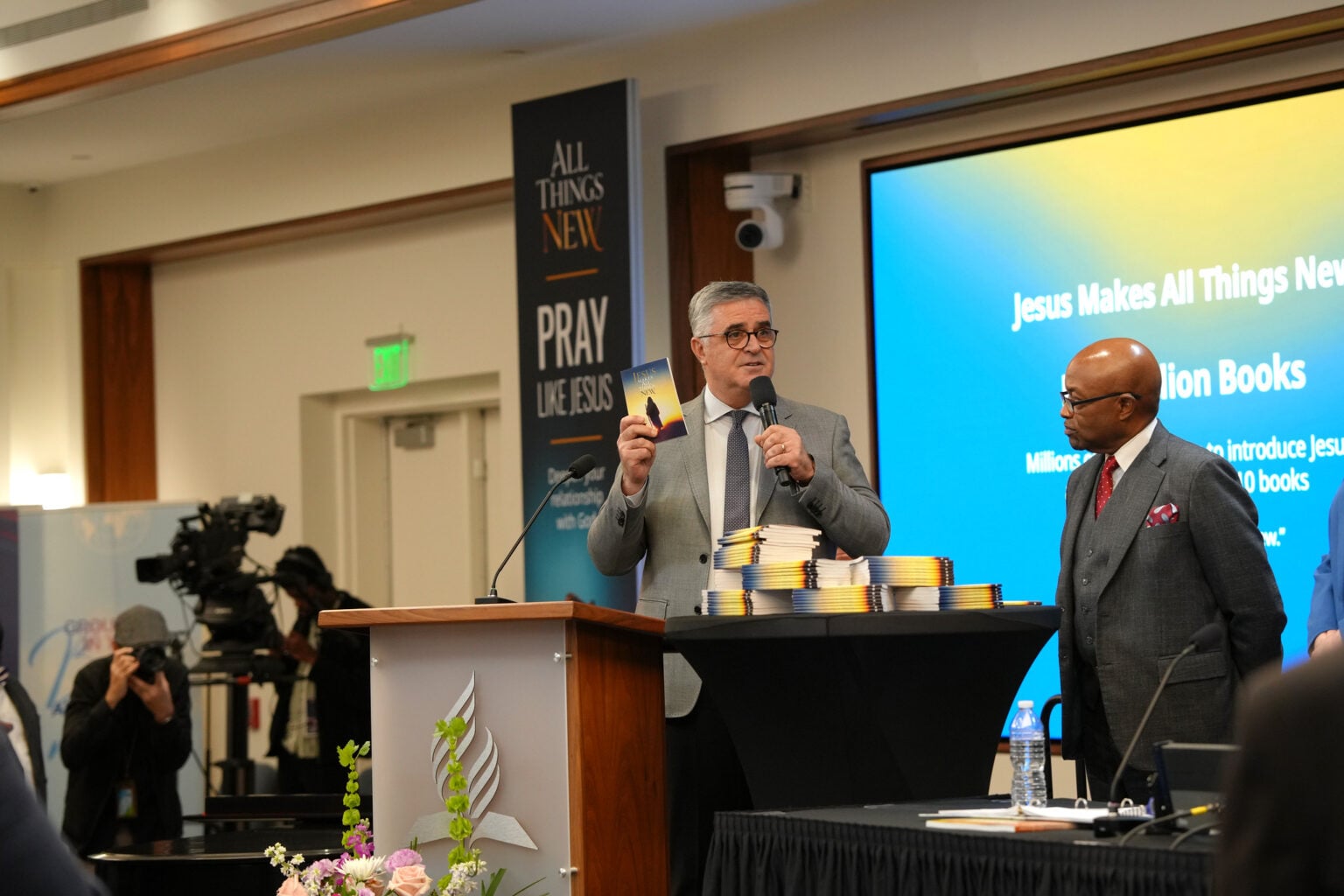
On November 1, day four of the North American Division’s 2026 NAD Annual Council, Kyoshin Ahn, executive secretary since 2020, presented his secretary’s report. His presentation examined the current state of the Seventh-day Adventist Church in North America; analyzed vital signs of church health, including baptism, attendance, and pastoral staffing; and shared how God is using ministries under secretariat for His mission.
Membership Trends Reveal Growth, Losses, and Financial Faithfulness
Ahn first shared that at the close of the third quarter of 2026, the NAD had nearly 1.33 million members, representing a net increase of 12,608.
He noted a steady upward movement in membership numbers over the past four years, as the division emerged from the compounded disruption caused by the COVID-19 pandemic.
Ahn reported that in 2025, the NAD had 43,052 total accessions, or added members, averaging 118 daily accessions. Even after accounting for membership transfer, baptisms represented the largest share of these additions, at 48 percent.
The division also recorded a net gain of approximately 2,000 members through transfers in 2025, with 28,000 transferring in and 26,000 transferring out.
Ahn stressed the importance of maintaining accurate membership records through the official transfer process. He cautioned against recording transferring members through professions of faith, as bypassing the transfer process “undermines the integrity of our global church records.”
He then shifted his focus to membership losses. “Any responsible stewardship of the church records demands that we look at both sides of the ledgers. We must confront our losses.”
In 2025, those losses totaled 15,759 across three categories he described as “painful:” deaths, missing members, and members dropped from the books.
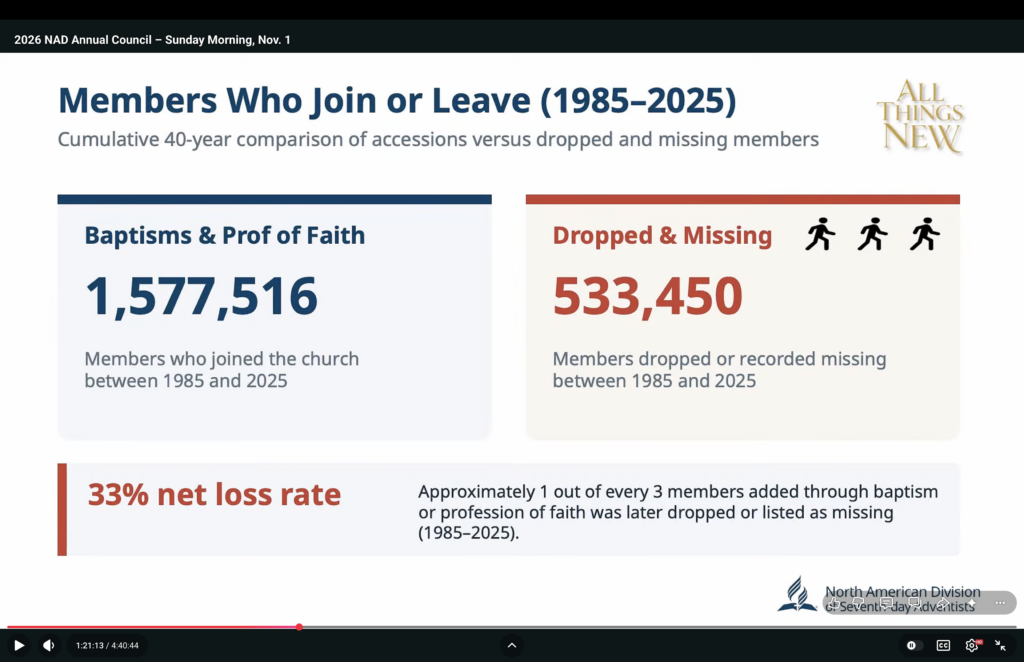
Examining NAD membership trends over the past 41 years, Ahn uncovered an even more sobering reality. While roughly 1.5 million people joined the church, 533,450 were categorized as dropped or missing. The net loss rate during this period was 33 percent.
“That means more than three out of every 10 believers who joined our families are slipping through our fingers,” said Ahn. “These are not just numbers on a spreadsheet. They are sons, they are daughters, and they are neighbors, and they are friends. This reality beckons us to pay closer attention to how we nurture and retain our new members.”
Finally, Ahn highlighted long-term membership growth and financial faithfulness. Over the past 45 years, the division recorded an average annual net growth rate of 1.8 percent, while the tithe growth rate average each year was 3.94 percent. During the same period, inflation averaged approximately 3 percent annually, with prices rising by nearly 300 percent cumulatively.
“We praise God for the sacrificial faithfulness of our members,” he said.
A Snapshot of NAD Membership
Ahn shared the two largest age groups in the church: 47 percent of NAD members are aged 30-59, and 31 percent are over 60. The median and mean age of the church is 49 years old. Furthermore, as the database reflects only baptized members, children under 12 represent only one percent of members.
Members in Bermuda, Canada, Guam-Micronesia Mission, and the United States worship in 6,761 congregations, including 5,876 churches and 885 companies.
As Bryant did in his opening presentation, Ahn positioned the NAD within the context of the world church, which has more than 24 million members.
“The North American Division represents 5.4 percent of that global family. We have been growing steadily, though not as rapidly as we had hoped. Some of our sister divisions have witnessed rapid growth, but our mission footprint remains essential.”
Baptisms Reach Highest Level since 2009
“In 2025, we celebrated 34,653 baptisms, our highest single-year baptism total since 2009,” Ahn stated, as delegates applauded. The NAD also recorded approximately 8,400 professions of faith.
Ahn shared that in 2009, a dedicated year of evangelism drove baptism totals to more than 41,000. He attributed the strong accession numbers in 2025, totaling more than 43,000, to Pentecost 2025 and momentum from the 2024 International Pathfinder Camporee.
“We give glory to God for every soul who entered the waters of baptism,” Ahn said.
Amid the baptism statistics was this gem — from 2008 to 2025, youth aged 10-19 led the division in baptisms, averaging 8,200 annually. “Our investment in children, Pathfinders, and youth ministry remains our most fertile mission field,” he asserted.
In what Ahn described as a surprising finding, young adults aged 20-39 also accounted for a significant number of baptisms, averaging 6,680 annually over the same period.
“This [result] reinforces our need to empower [members of] this group to be leaders in the local church,” Ahn said.
Baptismal Survey Points to the Power of Personal Connections
Ahn expressed NAD Secretariat’s desire to go beyond the baptismal numbers to the stories behind them. He then introduced Michael Campbell, director of the NAD Department of Archives, Statistics, and Research, to share the results of research on baptism and retention.
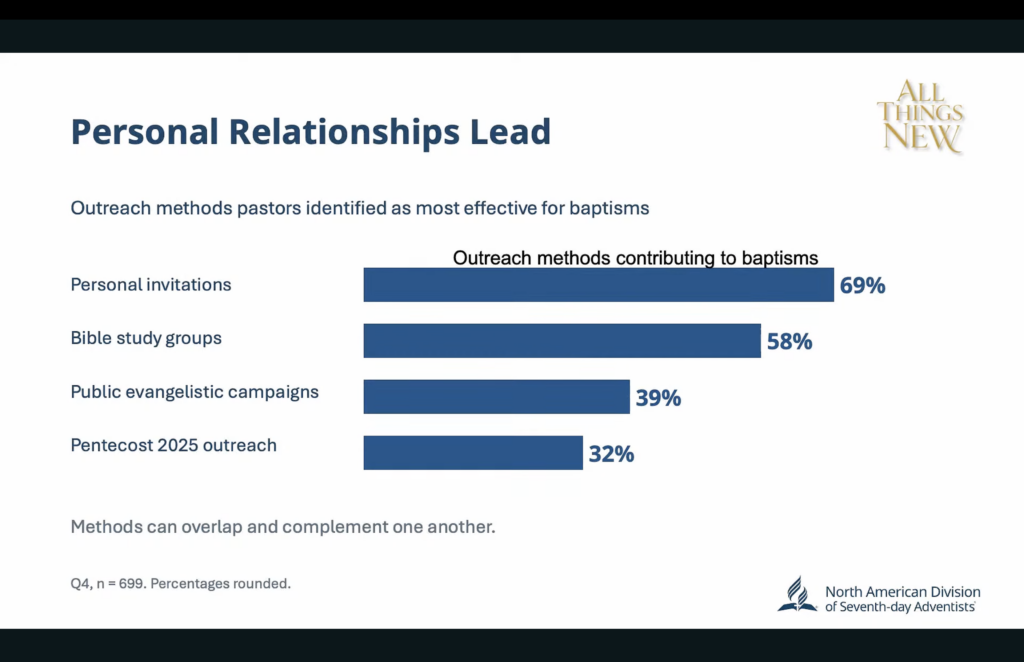
Campbell received responses from 705 pastors across the division. When asked which outreach methods contributed to baptisms, the leading responses were personal invitations (69 percent) and Bible study groups (58 percent), followed by public evangelistic campaigns (39 percent) and Pentecost 2025 outreach (32 percent). He noted that these methods can overlap and should be viewed as complementary.
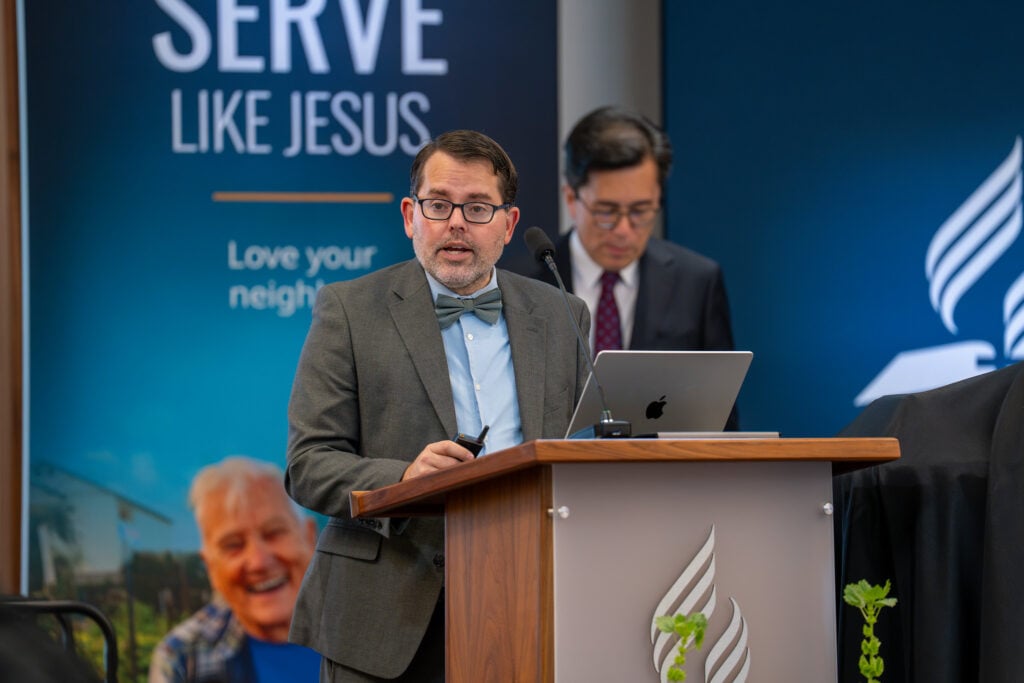
Similarly, when asked why they believed people joined the church, pastors most often cited a sense of community (30 percent) and personal invitations (23 percent).
Concerning retention, while 69 percent of pastors described new members as involved or very involved in church activities, only 52 percent rated their follow-up methods as effective or very effective. Small groups were the most commonly reported follow-up method, at 59 percent, followed by discipleship classes (40 percent) and mentorship programs (32 percent).
Campbell identified equipping members to invite others, providing accessible Bible studies, and surrounding new believers with spiritual support as priorities for local churches and members. He also said the findings suggested that “there is a genuine need to give each new believer an identifiable person who will walk alongside them.”
Vital Signs of the Church in North America
Ahn then shifted the focus from baptisms and new member retention to congregational health as a whole. He introduced Brian Ford, eAdventist membership services director, to “take the pulse” of the church in North America.
Ford likened monitoring church health to a medical checkup. The “vital signs” church leaders typically check are membership growth, baptisms, and tithe. Ford emphasized attendance as another essential measure.
Presently, two-thirds of NAD congregations track attendance through eAdventist. For instance, a church with 100 members and 40 people attending has an attendance ratio of 40 percent. Ford noted that before the COVID-19 pandemic, most churches had attendance ratios in the 30s, 40s, and 50s. After five years of recovery, the majority remain in the 20s, 30s, and 40s.
Attendance trends are also a major factor, along with baptismal growth, in categorizing congregations as declining, growing, plateauing, or multiplying. Ford shared that in 2025, slightly more than half of NAD churches were classified as declining, more than a third as growing, just under a sixth as plateauing, and 1 percent as multiplying.
Ford further explained that a church is considered declining if it records no baptisms in the past year or its attendance drops by more than 2 percent. Even churches baptizing new members are categorized as declining if their attendance decreases by more than 2 percent.
“What surprised us was that almost one-third of our declining churches are in this situation,” Ford said, underscoring that some congregations continue baptizing new members even as overall attendance declines.
Ford encouraged church leaders to monitor attendance to gain a more comprehensive and accurate picture of congregational health, while affirming that “each church can flourish regardless of size, age, ethnicity, or location.”
Empowering the Laity for Greater Impact
Following this presentation, Ahn reinforced the long-term challenge of one-third of declining churches “celebrating baptisms at the front, [while] their total weekly attendance is quietly shrinking out the back.” Then, he turned to a different issue — the pastor-to-member ratio.
The baseline pastor-to-member ratio across the NAD is one pastor per every 329 members. When volunteer lay pastors are factored in, however, that ratio drops to one pastor per 294 members. In one large conference, the ratio improved from one pastor per 433 members to one per 279 when volunteer lay pastors were included.
Ahn encouraged delegates to consider the potential of lay leadership in helping advance the mission. “We stand at a structural crossroads. Changing demographics and economy shifts encourage us — or even dictate us — to re-examine how we deploy, how we support, and how we equip our pastoral teams alongside an empowered laity.”
Mission: The Beating Heart of Secretariat
Ahn introduced the next section of his report by stating that beyond the statistics, “The beating heart of the secretarial work is mission.” The mission strategy of secretariat ministries rests on three pillars: 1) equip people for service; 2) sustain them while in the field; and 3) plant new communities of faith among the unreached.
Ernest Hernandez, director of Adventist Volunteer Service (AVS), formerly the Office of Volunteer Ministries, highlighted opportunities for individuals to serve both within the division territory and internationally. He reported that more than 350 long-term volunteers had served internationally in 2026, along with an estimated 11,000 short-term volunteers.
Hernandez also spoke about Sharing the Adventure Reading Starts (STARS), a growing NAD-wide tutoring and mentoring initiative, developed in partnership with Adventist Community Services, operating in roughly 16 locations across 11 states and in Bermuda. The program helps hundreds of children in at-risk communities.
Hernandez concluded with the testimony of Kyla Kneese, a student missionary serving in the Marshall Islands, who shared the lessons “amazing, chaotic” students had taught her about loyalty, forgiveness, and love. “I might be the teacher, but these kids are giving me the best education of my life,” she said.
Next, Orna Garnett, director of NAD Missionary Services, shared how her department supports more than 95 missionary families serving within and beyond North America.
“We help the church prepare missionaries well, support them while they serve, and we welcome them back home because while an assignment may end, the mission continues,” she began. She noted that, following discussions on tithe parity, Missionary Services had assumed responsibilities previously administrated by the General Conference on behalf of the NAD.
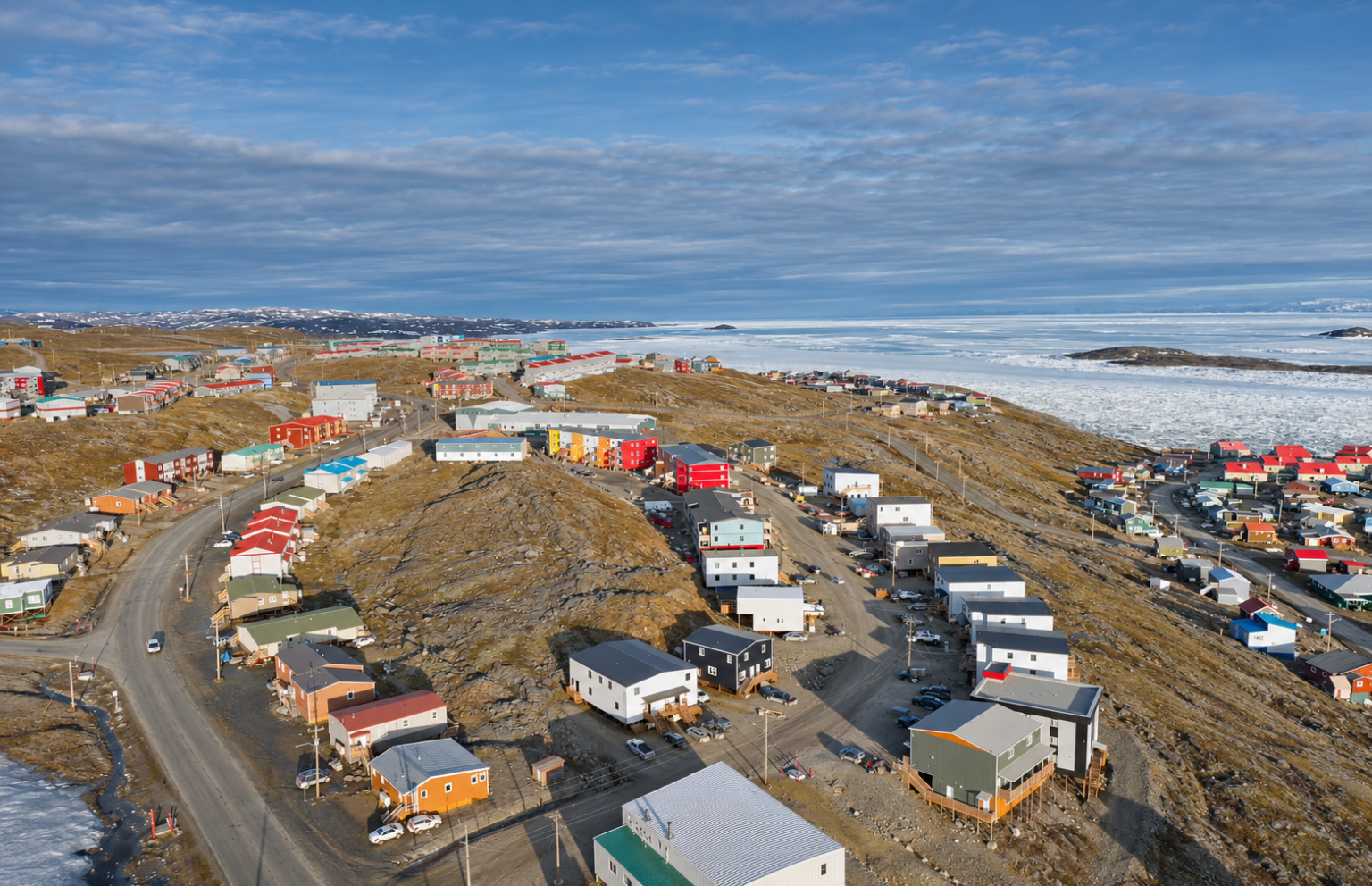
Garnett shared the testimonies of two missionaries, including Pastor David Bakunzi, who, with his family, serves in one of Canada’s most remote communities in Iqaluit, Nunavut. “Coming here to do ministry in this part requires a lot of listening, a lot of learning, and humility,” Bakunzi said in a video testimony.
Through a weekly soup kitchen, an Adventurers Club, and other outreach activities, the Bakunzis have built relationships and gained acceptance within the local Inuit community.
Another story featured Nick Walters, a medical doctor serving in Thailand. While Walters shared about the miracle of seeing lives saved, he emphasized that his work has become a means of sharing his faith, aided by his ability to speak Thai.
“Any opportunity to meet and talk to people has now become my mission, rather than just being a doctor seeing sick patients,” Walters said.
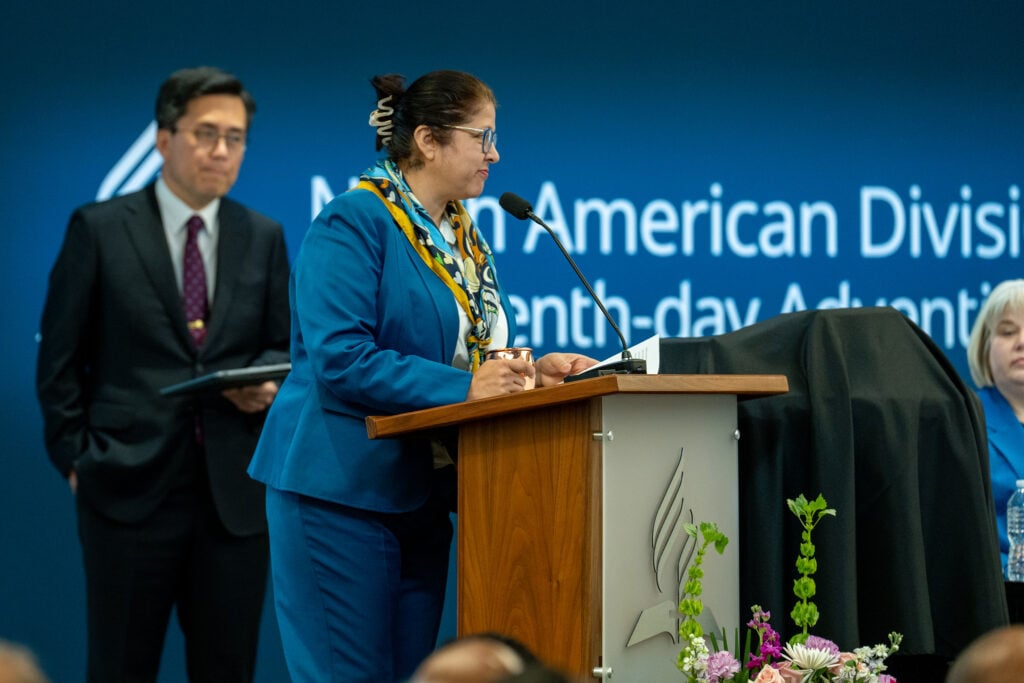
Finally, Gabriela Phillips, director of Adventist Mission for the NAD, spoke to continued efforts to reach three groups within division’s territory: post-Christian and secular communities, growing urban populations, and diaspora communities from the 10/40 Window.
Phillips described her department’s role as helping church leaders identify underserved populations, develop mission projects, and access funding and additional resources through partnership with the General Conference and NAD Ministerial departments.
Her report featured the testimony of a young man, named Drake Johnson, who has struggled with demonic oppression from childhood. He cried out to God for help one day, and felt God’s presence in the room. As a teen, he met an Adventist named Obed. After years of friendship, he agreed to do Bible study and get baptized. Today, he is involved in ministry as a Bible worker and church plant associate. His story illustrated the power of personal relationships in reaching the unchurched.
In closing, Ahn reiterated that “the role of the division secretary extends far beyond administrative logistics and statistical records. Mission is the reason for our existence.”
He reminded delegates that God’s mission began long before the creation of the world and that the church is invited to participate in His work. “God is the author and finisher of His mission. He started His mission, and He will finish it.” He concluded, to applause, “May God continue to guide and bless our mission here in North American Division territory.”
Following the presentation, delegates briefly discussed Indigenous outreach, attendance tracking, and baptismal trends among youth and young adults before voting to receive the report.