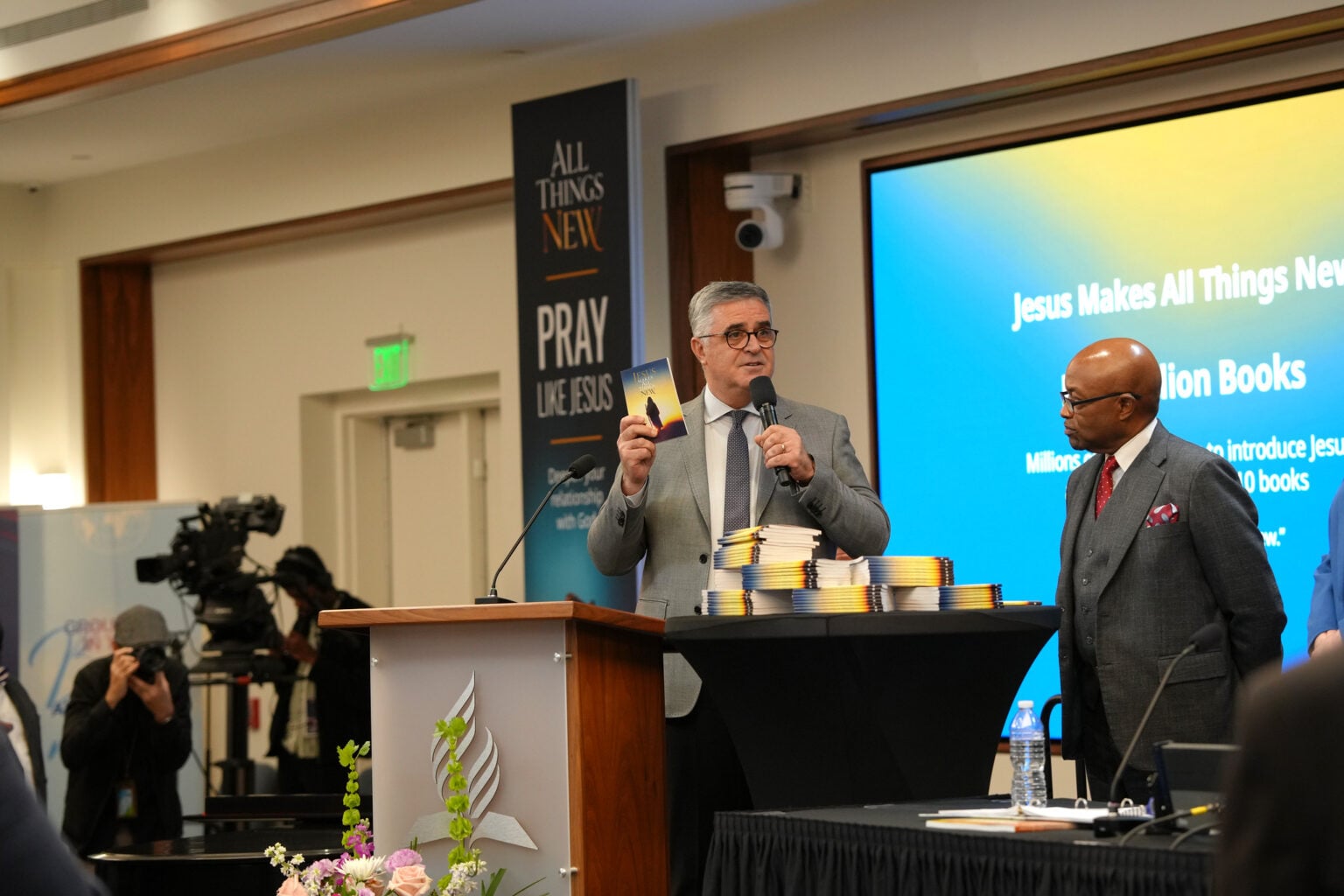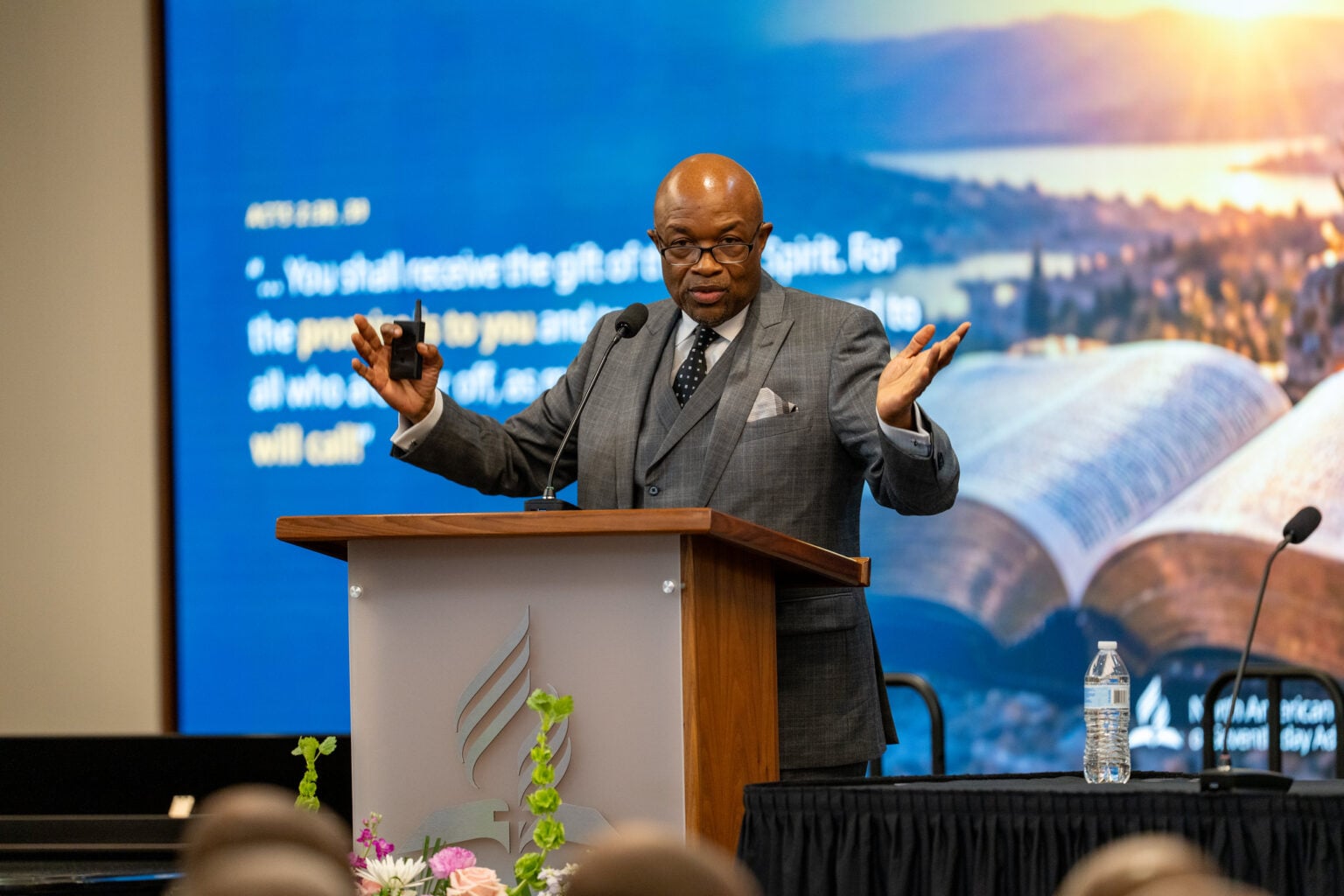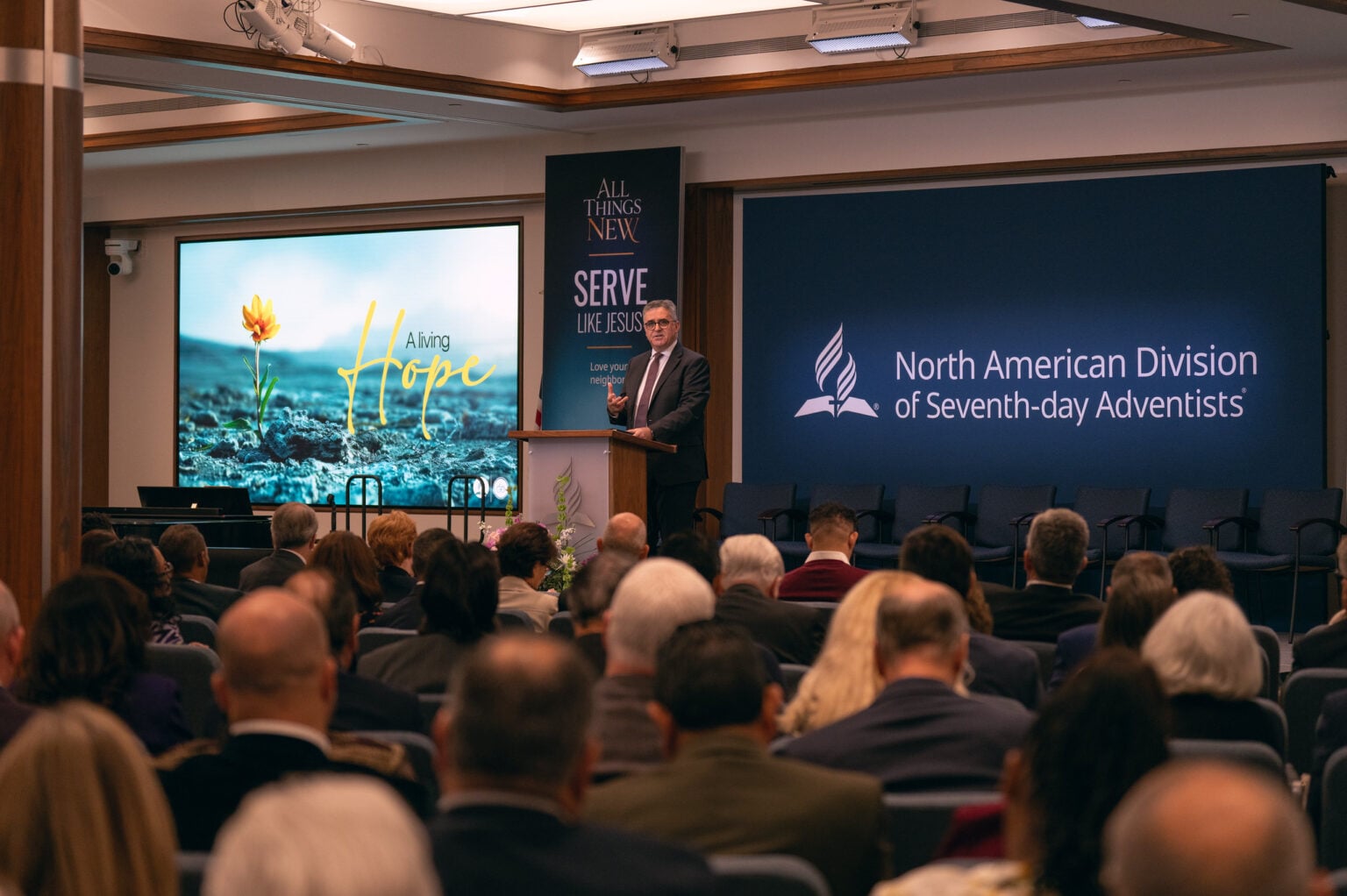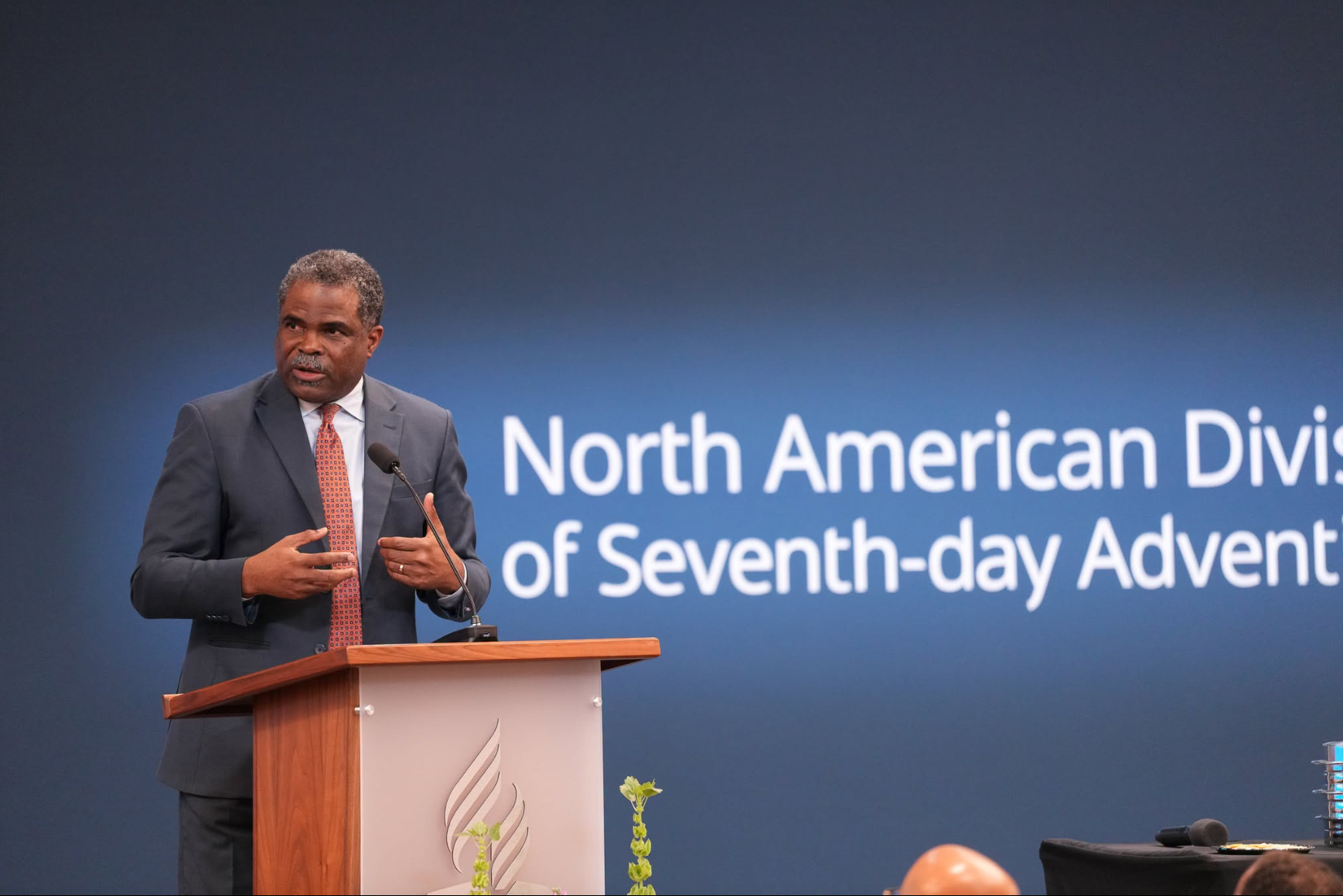
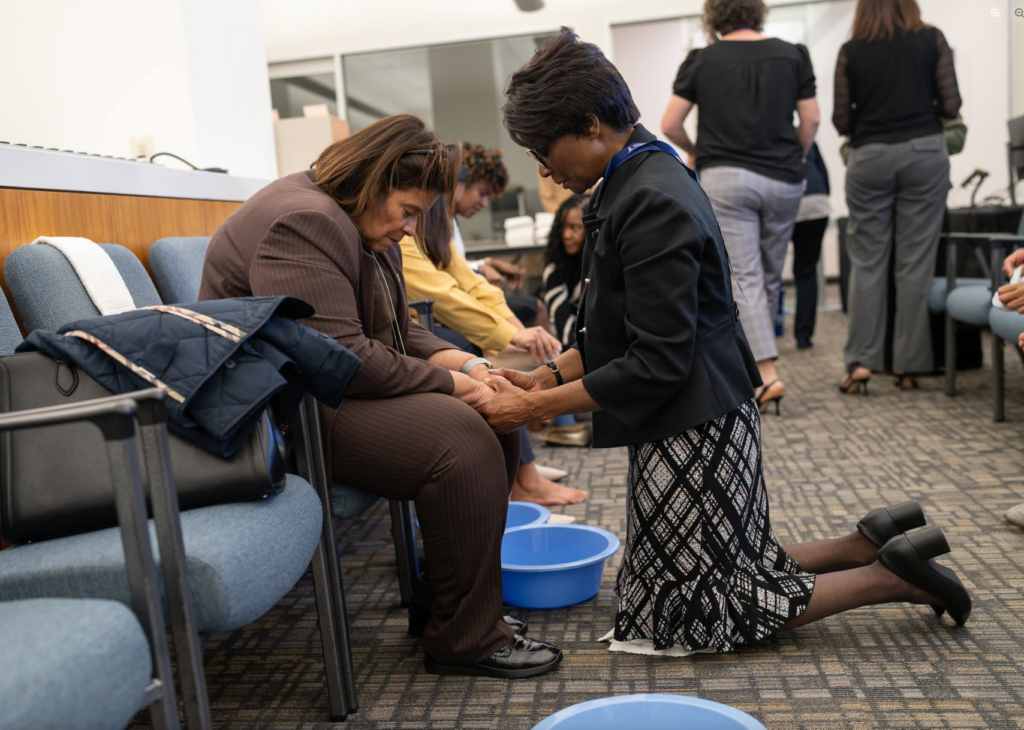
At Friday evening vespers during the North American Division’s annual council, General Conference treasurer Paul Douglas preached from 1 Corinthians 11 after executive committee members and guests shared an agape feast and foot washing. His message led the group into communion.
Church leaders, who had spent the day in meetings, set their titles aside Friday evening to share a meal, wash one another’s feet, and take communion together. When they gathered for the evening worship, the treasurer of the world church asked what they would carry home.
“If we partake together, we must proclaim together,” said Douglas.
From the Table to the Basin
Rick Remmers, assistant to the NAD president and a newly elected General Conference vice president, welcomed the group. He noted that many leaders worship in a different church each week and rarely take part in a communion service due to their travel schedules, so this chance to share in this experience together is meaningful.
Remmers introduced Douglas as a leader who “emphasizes faithful stewardship, transparency, accountability, and directing resources toward the church’s mission.” Douglas joined the General Conference Auditing Service in 1986 and served as its director for 14 years. He has led the world church’s finances since 2021 and was reelected at the 2025 General Conference Session in St. Louis, Missouri.
NAD leaders Andre Bill Watson-Payne, Sabbath School and Personal Ministries Director; and Angela Li , an associate director of Adventist Chaplaincy Ministries, led song service and a season of prayer. They guided the room through different prayer areas, focusing on repentance, confession, and soul searching.
Douglas felt that the evening’s movement from the agape feast to foot washing to the communion service provided many lessons of servant leadership. “At the basin, there were no positions,” he said. “There was no rank. . . . The water reminded us of cleansing. The towel reminded us of service. And the ordinance reminded us that greatness in the kingdom of God is measured by humility.”
Partakers Have a Purpose, Power, and a Promise
“What should this sacred gathering lead us to do? Is the blessing of communion complete when the service ends? Or does the Lord’s table send us forward with something greater to accomplish?” asked Douglas. “That’s the question for us tonight. And I believe my name’s sake, the Apostle Paul, answers that question.” Douglas then centered on three biblical points based on 1 Corinthians 11:26: “For as often as you eat this bread and drink this cup, you proclaim the Lord’s death till he comes.” Paul, he said, “moves from remembrance to proclamation.”
Purpose. The Greek word for proclaim, katangellō, means to announce or make known, Douglas explained. Every communion service is a declaration. “We do not come to celebrate what we have accomplished for Jesus Christ,” he said. “We come to remember what Jesus Christ has accomplished for us.” He told administrators, educators, health-care workers, and pastors that their roles differ, “but our purpose is shared.”
Power. The church needs planning and stewardship, Douglas acknowledged, but its greatest need is the Holy Spirit. “The power is connected to the proclamation. The gift is connected to the assignment,” he said. That power, he added, is “not to advance our own importance. The power is to advance His kingdom.”
Promise. The words “till He comes” give the mission both urgency and hope, Douglas said. He drew laughter with a nod to his own work: “Paul did not say we proclaim until the budget is balanced. I had to put in a treasury thing in there.” For leaders facing slow progress or limited resources, he offered assurance: “We serve a Savior who has promised to finish what He started.”
“Do not let the circle break where you stand”
Douglas ended with a memory from childhood communion services. Members stood in a circle and counted off one by one to see who was present and who was missing. Then came a line that has stayed with him all his life: “Do not let the circle break where you stand.”
This applies to leaders heading home to their conferences and institutions, and to the church’s plans for 2027, Douglas argued. “Whatever the difficulties, whatever the high, whatever the low,” he said, “do not let the circle break where you stand.”
“I believe we know by now that the church does not depend on human ability, said Douglas. “Yes, we need wisdom. Yes, we need planning. Yes, we need organization and faithful stewardship. I agree with all of those things. But our greatest need and our most precious gift is the presence and the power of the Holy Spirit.”
Douglas reiterated, “I’m here to tell you tonight, we serve a Savior who has promised to finish what He started. And this promise gives us hope and courage when it gets difficult. Patience when things are not seen immediately and hope when the needs of the world seem overwhelming to all of us.”
The service then moved to the final communion ordinances by the group intertwined with prayers and singing.