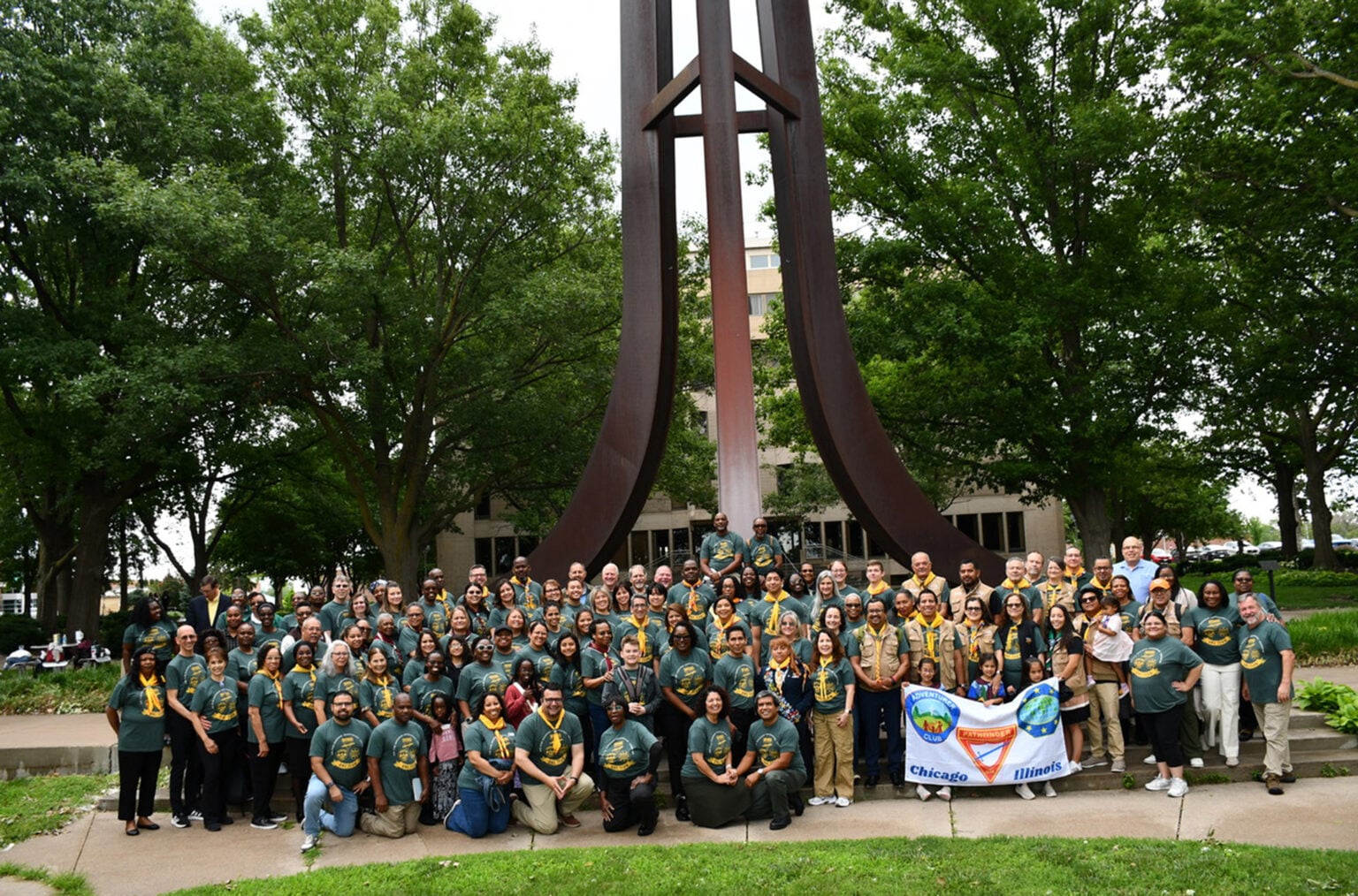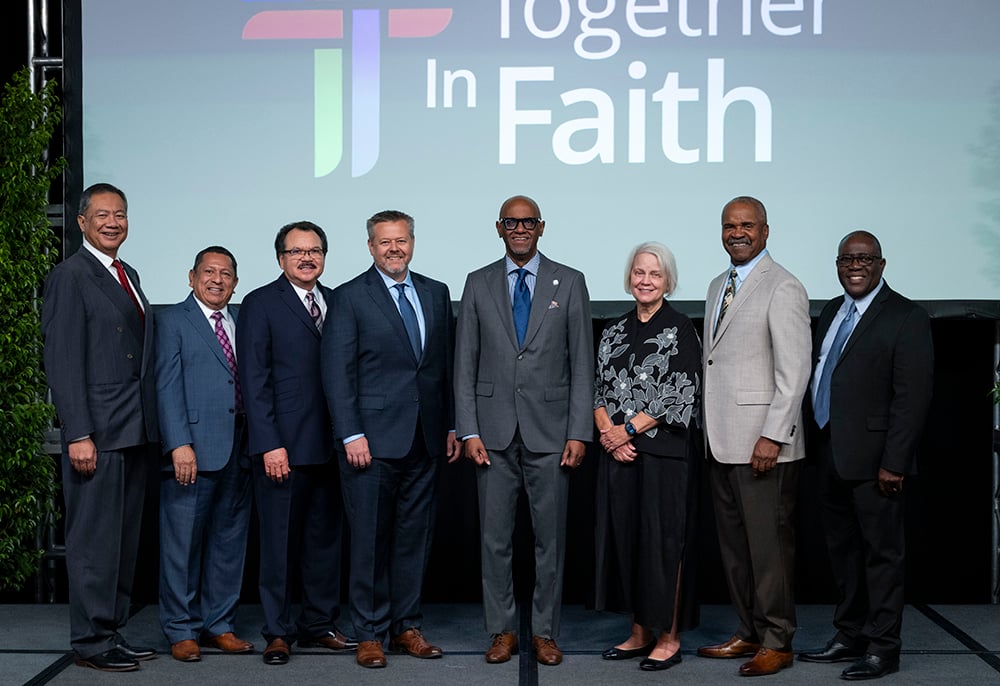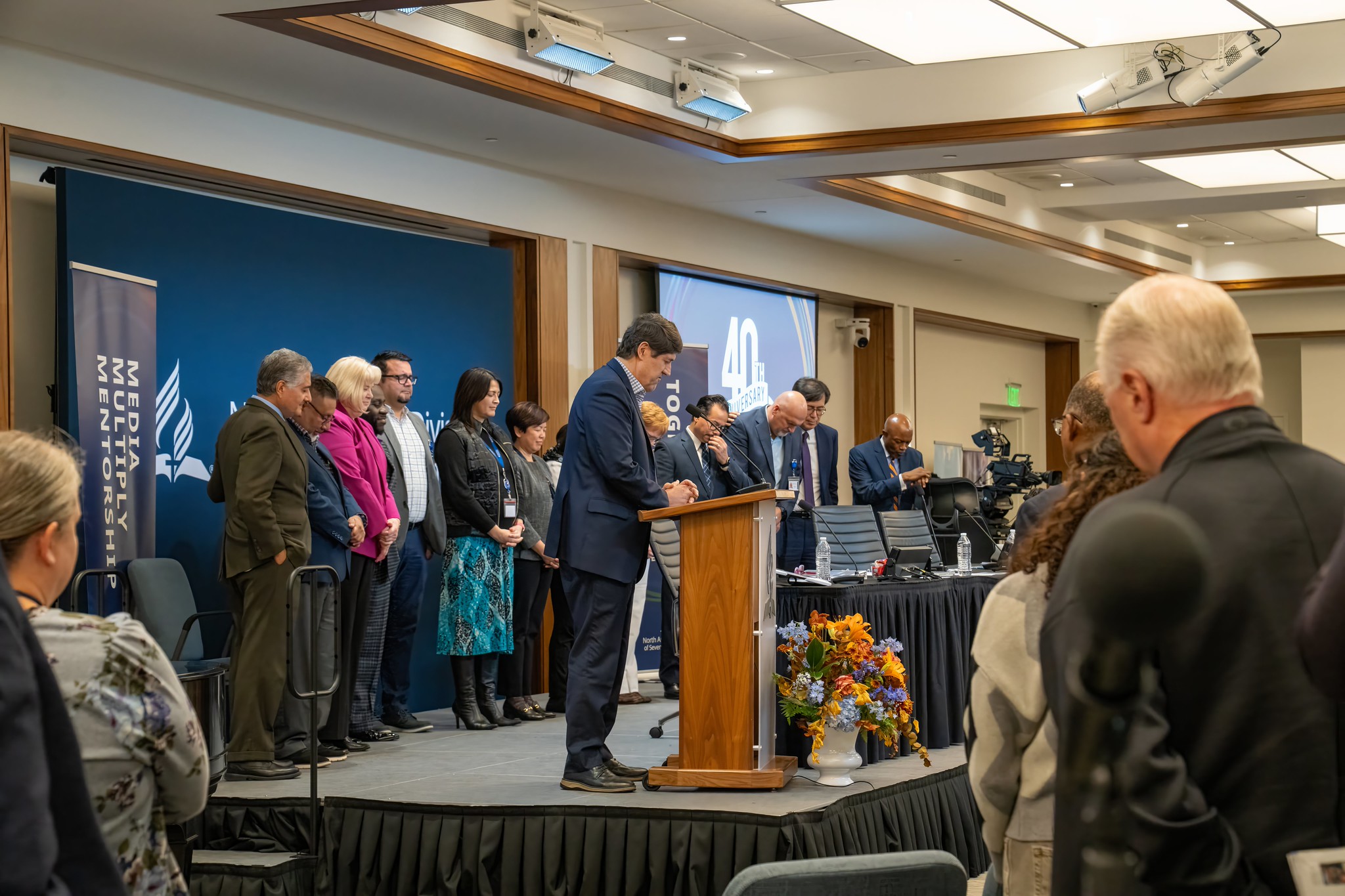
On a bright sunny Nov. 4, 2025, morning, attendees of the North American Division (NAD) Year-End Meeting gathered for the six and final day of worship and business sessions. The business agenda of the day included receiving the remaining ministry and organization reports, the fulfillment of membership duties, as well as discussing and voting on the final policy items.
Guam-Micronesia Mission Officers Election and Report
In the Seventh-day Adventist Church administrative structure, a “mission” is a small administrative office that oversees a territory that requires external financial and other forms of support at this stage of its development. The Guam-Micronesia Mission (GMM) is the newest territory in the North American Division, having been transferred to it in 2011. The mission encompasses eight to nine major islands, of which several are United States territories, and thus it was decided that it made sense for the administration to come under the same division that includes the United States of America. Because the Guam- Micronesia Mission operates as a division-attached mission, the year-end meeting constituency serves as the electing body for its officers. Following recommendations from the NAD President’s Council, the body elected three officers to serve for the quinquennial (five-year) term: Matthew Kirk will continue as president, Pablo Gaitan was elected as executive secretary (filling a position that had been open for a couple of years), and Marcey LaChance will continue serving as treasurer/CFO. Gaitan is currently a senior pastor in the Potomac Conference of Seventh-day Adventists. The recommendation was approved unanimously by the assembled delegates.
President Matthew Kirk reported that the GMM is navigating significant organizational restructuring while experiencing encouraging growth. Because many of its entities were formed when it was part of the General Conference Corporation and it exists across three countries, there has been a lot to untangle. The mission is completing major legal restructuring, including merging its unincorporated association with the North American Division corporation and transitioning clinic ownership as well. Both changes will take effect January 1, 2026. “On the evangelism front, God has been doing miracles and blessings through the Pentecost 2025 initiative,” reported Kirk. Looking ahead to the mission’s upcoming quinquennial session, Kirk emphasized the dual focus of “foundations and frontiers” — strengthening organizational infrastructure while reaching unentered territory. He expressed gratitude for his leadership team and requested prayers as they continue to work toward conference administrative status and full alignment with NAD working policy.
Policy Agenda/Consent Agenda
“So we’ve come to your favorite moment,” joked undersecretary Jorge A. Ramirez as he began the session on policy review. Policies are essential for the unity of the church and these are reviewed and approved at every year-end meeting. There were nine policy proposals for consideration spanning such topics as credentialing, political activities, financial assistance, and human resources.
Before policies are brought to the NAD executive committee, they go through an extensive review process by union officers, allowing for feedback and recommendations. Most passed without much debate, including updates to emeritus credentials (E 05 40), new guidelines for minimizing partisan political activities in churches (FL 01 30), a Conference Special Assistance Fund policy simplification related to the calculations of support for the church membership management system eAdventist (S 74), and a new Asian Church Building and Scholarship Fund policy (S 83 05).
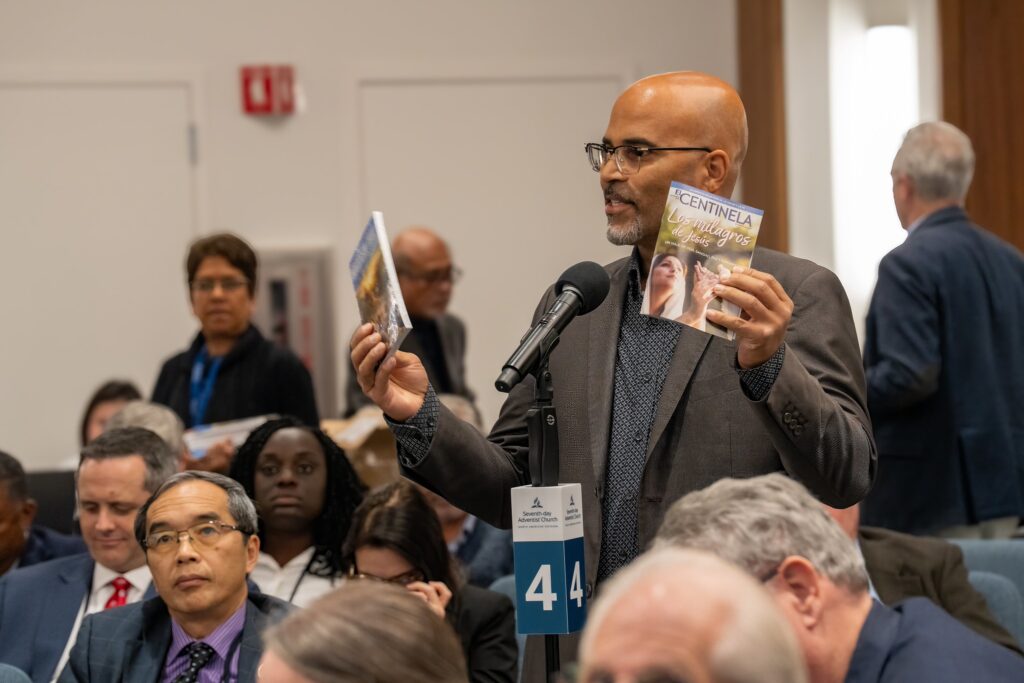
Pacific Union Conference attendee Vic Louis Arreola rose to thank the group for the approval of the Asian Fund policy saying, “on behalf of the more than 500 Asian churches in this division, I would like to celebrate and thank the administration and executive committee for approval of the historic policy on the Asian building and scholarship funding, we have grown tremendously. We have donated to the church $92 million in 2023 in our tithes, and we are operating 33 language groups throughout this [territory]. Again, we praise God and thank you.”
Four interconnected HR policies addressing vacation and holidays (E 75), sick leave (E 82), and family/medical/military-related leave (E 83) and the Employee Disability Income Plan (Y 33) were approved as a package, with delegates particularly appreciating the parental leave provisions of up to 12 weeks but noting that there are not yet division guidelines on the minimum amount of leave required to be given, as this is currently controlled by local employer policy and/or state law and this can leave gaps as well as differences between denominational employers in the same geographical area.
The most passionate discussion centered on policy Y 24 15 regarding state-provided educational assistance scholarships. Delegates raised concerns that the policy would reduce benefits for employees by calculating church tuition assistance only on the remaining tuition after state scholarships were applied, rather than on the full tuition amount. While administrators explained the intent was to prevent families from receiving cash refunds when combined assistance exceeded tuition costs, several treasurers and conference leaders argued the policy unfairly diminished employee benefits and lacked sufficient flexibility for varying state regulations. After extended debate, delegates voted to pull Y 24 15 from consideration for additional review, while approving all other policies presented.
There was also a group of policies presented as a consent agenda, meaning they are reviewed and voted as a group. This is done for items that are primarily editorial in nature with non-material changes. The consent agenda was approved, and this ended this section of the business meeting.
“[Policies] are more than guidelines, they are agreements that we make [with each other] on how we will deal with certain issues in the church,” said G. Alexander Bryant, NAD president. “They are a result of our learning from different instances that happen in various places across the division. And so we then create the policies, hopefully … that will keep us together, but also out of harm’s way.”
NAD Corporation and Other Membership Meetings
Outgoing General Conference of Seventh-day Adventists’ General Counsel Karnik Doukmetzian came to the podium again to oversee the membership meetings of four additional corporations and other entities where the North American Division Executive Committee serves as the membership. Doukmetzian explained that the church, at many levels, needs corporations to hold asset titles and register trademarks.
As the membership of the North American Division Corporation, the group appointed the board of directors that will serve for the next five years. For the corporation connected to Adventist Community Services, the membership appointed its board and made minor changes to its bylaws.
For the Adventist Information Ministry (AIM), the group received its ministry report and approved the change of its name to Adventist Connect, minor changes to its bylaws, and confirmed its board members. Doukmetzian explained that Adventist Connect “is not a corporate body. It is doing business as a DBA of the North American Division, but this group here forms the membership.”*
For the final organization, Seminars Unlimited is not a corporation or a DBA of the division, but the NAD does serve as its membership and thus also appointed its board for the coming five years.
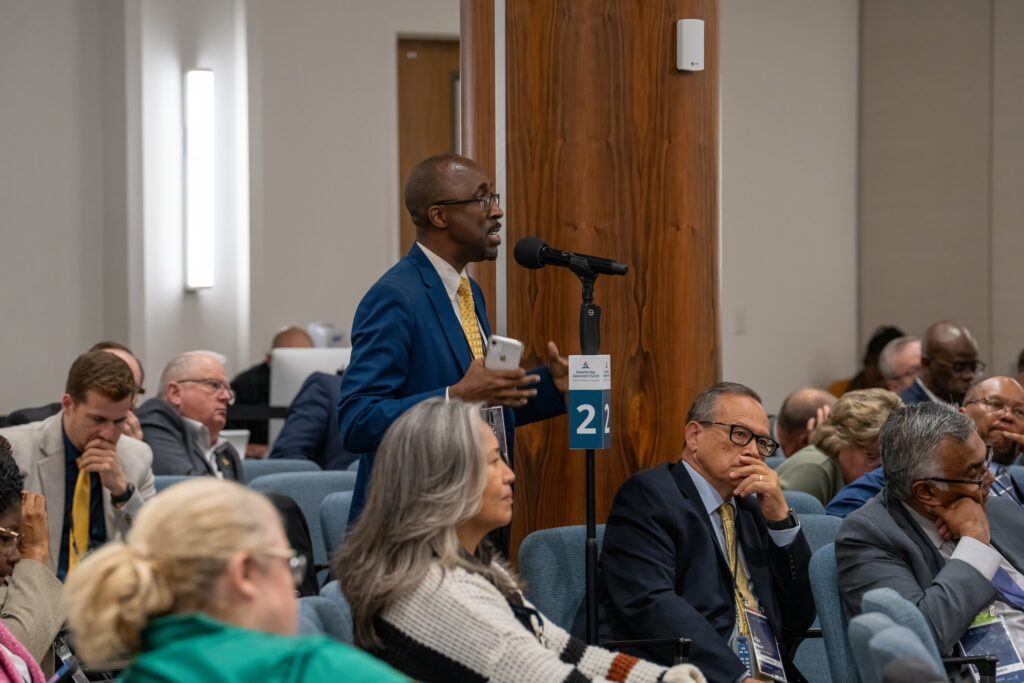
After the appointments of one of the boards of directors, Columbia Union Executive Secretary Celeste Ryan Blyden came to the microphone to make a statement to the group about the composition of the boards. She recognized that people often are placed on these boards by virtue of their position, which by default results in a much higher percentage of men being on the boards than women, despite the fact that more than 50 percent of church membership is women. “Even though we love our brothers,” said Blyden, “it’d be nice to have some women’s voices at the table when we’re making decisions that impact the audience, the membership, and those we’re trying to reach. Let’s look to add some more women at the table so that we can diversify, … so we can hear each other, and we can all contribute to the mission and advancement in the church.” Her statement was met with applause from the audience, and Bryant agreed that should be done, noting that the appointed boards do have the right to add additional members and should do so. He also pointed out that another group left out by these position-based appointments is younger members, and that this should also be considered.
Ministry Reports
Links and summaries of the video reports for the ministry departments (Volunteer Ministries, Health Ministries, Public Affairs and Religious Liberty (PARL), Sabbath School and Personal Ministries) can be found here, and Adventist Connect and Adventist Community services can be found here.
Office of General Counsel Report
General Conference general counsel and NAD Year-End Meeting parliamentarian Todd McFarland issued two important notices to conference and union leaders during YEM. First, he requested that any church entities participating in state unemployment compensation programs let them know, as recent Supreme Court rulings have raised new constitutional questions about churches’ traditional exemption from these programs. Second, McFarland, while acknowledging that Bob Burrow serves the NAD as general counsel, announced that his office will continue providing legal services to the NAD, including parliamentary services for conference and union constituency meetings. He encouraged leaders to reach out to the GC Office of General Counsel for assistance with their sessions.
Closing Statements
“We have been talking for the last several days about the mission and what God has called us to do, and the moment and the time he has called us to do it,” said Bryant as he began his closing remarks. “I believe all of us are where we are at this particular moment by the direct guidance of the Holy Spirit.”
Returning to the opening Scripture from Acts 2 about the original Pentecost experienced by early believers, Bryant emphasized that “the requirement of the Holy Spirit was not for the disciples to be perfect, and we see that they were not perfect. They had issues all through the book of Acts. It wasn’t perfection that was a requirement, but unity that was a requirement — coming together in one place, in one accord, one purpose, one mission, and that’s the intersecting place where the Holy Spirit falls upon His people.”
Using the metaphor of a symphony orchestra, which can be chaotic when it is practicing but comes together with a conductor, Bryant said. “Our Conductor is Jesus,” comparing the diverse roles and backgrounds within the church to that of the diversity of the orchestra members. “We have different instruments that we play and different roles and functions that God has called us to at different organizational levels,” he said. “But when the orchestra keeps its eyes on the Conductor, it is the Conductor that brings unity to the body and makes the beautiful music.”
Bryant warned that Satan’s strategy is to attack the church from within. “The devil said, my best weapon is not to attack them from without, but to attack them from within. Let them turn their arsenal against each other,” Bryant said. “But greater is He that is in us than he that is in the world. We are stronger together. We will make it together. We will be victorious together, and we will defeat our enemy together — together in mission.”
Together, everyone stood to sing the song of the last two year-end meetings, “Come, Holy Spirit.” Bryant concluded with a prayer for a double portion of the Holy Spirit and safe travels for all delegates returning home.
* DBA stands for “Doing Business As,” meaning the entity uses a separate trade name to operate, but is still a part of the parent entity, which in this case is the North American Division Corporation. This allows for branding flexibility without forming a new business entity.