Kyoshin Ahn, executive secretary for the North American Division, presented the secretary’s report on Friday, October 31, 2025, during day two of the year-end meeting. He began by thanking those present for electing him to another five-year term as secretary, saying, “I do not take my responsibilities lightly and I intend to serve this church and its members very well.” Ahn then shared that eAdventist, human relations, Office of Volunteer Ministries, human resources, Archives, Statistics & Research, and professional services report to secretariat; he thanked each person who serves in secretariat and the areas it oversees.
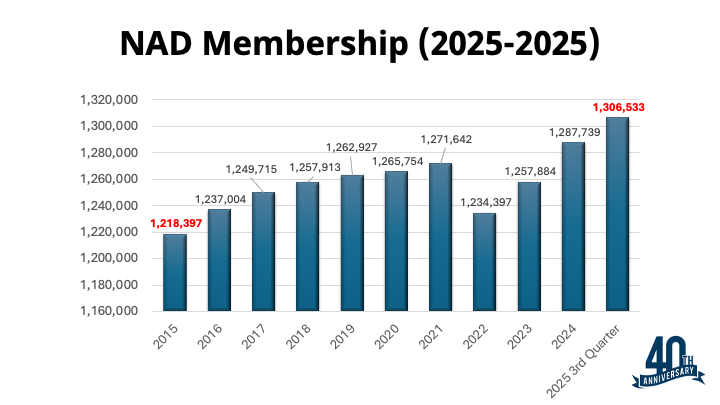
In 1867, Ahn shared, the NAD had 4,320 members. In 1985, when the NAD was reestablished as a separate entity from the General Conference, the number was 669,587. During the past 40 years, membership in the NAD has nearly doubled, bringing the total to 1,306,533 — as of the third quarter of 2025.
“We had 33,168 baptisms in 2024, the highest in our recent history,” Ahn shared. “By the end of the third quarter this year [2025], we have 23,358 baptisms.” Along the same lines, Ahn continued, 9,241 members joined the church via profession of faith, the highest number since 2013. “At the end of 2024, we added about 73,000 people to our membership through baptisms, professions of faith, or transfers.”
Comparing the growth of the NAD during the first 10 months of the year to its growth in November and December of each year from 2008 to now, Ahn pointed out that the highest Nov./Dec. numbers were in 2009, during a division-wide evangelism effort to advance missional work. Because we are in a similar situation with Pentecost 2025, Ahn projects that growth in the final two months of this year will be close to 2009’s numbers, if not greater.
Ahn paused to explain that while the NAD uses eAdventist Membership and other divisions use ACMS, the two systems work well together. He further emphasized that professions of faith should not be used as a substitute for proper membership transfers between churches, noting that maintaining clear processes is vital for the integrity of church membership records.
As of the third quarter of 2025, there are more than 5,800 churches and nearly 900 companies in the NAD. “These numbers have remained essentially unchanged since 2024,” Ahn commented. “While new churches are being established across North America, this stagnation is primarily due to the consolidation of smaller churches.” Many of those new congregations recently established are still in the group stage of development, thus not counted in this statistics, he added
From 2014-2016, the rate of net growth in the NAD averaged around 17,000. In 2017 it began to drop, but after an all-time low during the pandemic, there was a significant resurgence year-to-year, and in 2024, the NAD saw a net growth of almost 30,000 (growth rate of 2.37 percent) — the highest in the past decade.
Modern History
At this point, Ahn announced they would be moving into the second part of his report, which was focused on the NAD’s history over the past 40 years. He then explained the miniature churches each attendee had received when checking in. “This is a model of Washington Church in New Hampshire where Sabbath-keeping was first practiced among Adventists,” he said. “It occupies a significant place in our history.”
Included as part of the secretary’s report were several video reports from various departments housed under Ahn. This included Michael Campbell, director of NAD Archives, Statistics & Research, who spoke on why 1985 is considered the year the NAD was established.
“In the 1970s and 1980s, more attention was needed to focus and create resources in North America,” Campbell said. “Eighty percent of the resources and two-thirds of the church’s missionaries came from North America during those decades. Charles Bradford, vice president for North America at the GC at the time, proposed that North America itself be seen as a “true mission field.” Other church leaders agreed, and in 1985, the world church gave North America its own autonomy and status. On July 1, 1985, Bradford was officially elected the first president of the North American Division.
Membership Matters
Brian Ford, director of eAdventist Membership Services, provided a report of the demographics of the North American Adventist Church. The median age of members is 48; in the U.S. the median age is 39, and in Canada it is 40. Females make up 54 percent of new members and total membership. Two-thirds of North American church members are over 20.
Jorge Ramirez, undersecretary for the NAD, reported on membership numbers. Each year throughout the past four decades, following the removal of members who have died, are missing, have been removed, or have transferred out, the net growth of the NAD has been consistently between 1,000-2,000. As a note, Ramirez commented that until 1998, baptisms and professions of faith were reported together. This is no longer the case.
“While the growth of the church over the past several years has been on a steady decline, things have begun to increase,” Ramirez said. “The lowest percentage of growth in North American history was 1.38 percent in 2020, due to the pandemic. In 2024 that percentage was 3.37.”
Pastoral and Educational Leadership
Danielle Toddy, director of Human Relations for the NAD, provided perspective on pastoral and educational leadership in the division. The number of pastors has “stayed relatively stable over the decades,” she stated, averaging approximately 4,000 from year to year. Retirements have begun a gradual decline since the early 2010s.
In 1989, there were more than 4,200 teachers in the NAD; in 2015, that number had shrunk to 2,500. “Though the number of schools has also dropped,” Toddy said, “surprisingly the number of elementary enrollments has remained relatively stable.”
There are currently 2,900 elementary teachers working with 51,000 students in 700 schools across North America; 1,150 secondary teachers serving nearly 9,000 students at 120 schools; and in higher education, 4,400 instructors work with 21,000 students.
“Through all of these shifts, one thing remains constant,” Toddy concluded: “The commitment of pastors and teachers to shape lives, grow faith, and carry forward the vision of Adventism in North America.”

Mission to the World
Orna Garnett, associate secretary of missionary service, shared onscreen the history of missions in the NAD. By 1930, 80 percent of the global mission workforce came from the NAD. That number remained at nearly ⅔ of the total (63 percent) between 1931 and 1970.
Today 100 families from the NAD are serving in 35 countries. “And not all of them are U.S.- born,” Garnett commented. “Our missionary community now reflects the diversity of the world church, embodying the principle of mission: from everywhere to everywhere.”
Carolyn R. Forrest, associate secretary/director of human relations, and Ernest Hernandez, director of the Office of Volunteer Ministries, presented via video on the student missionary movement in North America. There is a direct connection between the early 1900s “Foreign Mission Bands” and the beginnings of the student missionary program of our day,” shared Forrest. “In 1959, the Foreign Mission Band leader at Washington Missionary College, Ronald Laffler, was appointed to a new experimental program of missionary apprenticeship, spending a summer in the Inter-American Division. By 1962, those sent for summer missionary apprenticeships were described as ‘student missionaries,’” a term still used today.
Hernandez shared that the need to standardize and structure volunteer deployments began with an attempt to open an NAD office that would oversee volunteer recruitment at the 1995 NAD Year-End meeting, with the first volunteer office, sponsored by Adventist-Layman’s Services & Industries. By 1996 NAD administration decided to launch the ministry with the name Adventist Youth Service Network or “YouthNet” as a service of the Youth Ministries department.
“Over the next four years, YouthNet began to grow quickly, recruiting volunteers from eighteen to 48 years of age. With the inclusion of volunteers beyond the age of youth ministries’ the operation was moved from the Youth Ministries to NAD secretariat in the autumn of 2000; and in that year, the operation was renamed the Office of Volunteer Ministries (OVM).
Long-term service (1+ years), he shared, rose from a few hundred in 1996 to 1,000 by 2009, and short-term service participation rose to 55,000-60,000 annually, primarily ministering to children through mission schools and programs, especially in the Guam Micronesia Mission with almost 90 percent of student volunteers processed there coming from NAD universities.
Hernandez explained that with such an outreach, by 2016, OVM and Adventist Risk Management proposed the use of Sterling Volunteers to include criminal background checks and provide child protection training modules. “Since 2017, Sterling Volunteers has screened more than 300,000 volunteers and employees within the United States,” he reported, with the web portal page for the volunteer screenings consistently in the top three accessed pages on the NAD corporate website, year after year.
He indicated that strong relationships are being formed with Adventist Community Services, ADRA International, Public Campus Ministries, and health organizations within NAD for mutual support in foreign and domestic deployments.
A Walk Through Financial History
Campbell came onscreen again to talk about tithe in the NAD. In 1985, annual tithing was $118/church member globally and $498/church member in the NAD. In 2024, it was $137/church member globally and $1,079/church member in the NAD. This was despite the NAD having only 15 percent of the total global church membership.
“The NAD has much less influence with votes during decision-making processes, including GC Session,” commented Campbell. “The NAD still provides many times more than its proportionate amount of membership to supporting the world church, and remains the financial backbone of Adventist mission and expansion of the church.”
Bonita Joyner Shields, associate secretary, shared on the support of evangelism efforts of the world church, and how North America contributes toward those efforts. This is done through ingathering, which began in 1908; “Hope for Humanity” (U.S.) and ADRA Annual Appeal (Canada); and more.
“Culture has shifted and many people are no longer comfortable approaching people at home or work,” Shields said. “We need to support those who are eager to use this traditional method, and explore digital methods for others.”
Changes in Contribution
The next report was provided by Judy R. Glass, treasurer and CFO for the NAD, who shared the history of the 2019 decision to have divisions contribute an equal percentage of their tithe. When NAD leaders asked GC leaders to reevaluate tithe parity, the NAD was contributing 6.1 percent of its tithe to the global church, and all other divisions were contributing 2 percent.
“The request wasn’t that other divisions be made to pay more,” Glass explained, “Rather, the request was that the GC reduce its operational expenses in favor of the local conferences and churches where boots-on-the-ground ministry was happening.”
Because of the amount of time the NAD and GC operated as one entity, many policies and procedures are woven together between them. Though it took time to untangle them, in 2019, the Annual Council of the GC voted to reduce the NAD’s tithe contributions. Other areas of disparity that were identified during this conversation included how auditing services were deployed and paid for, and how GC employees were funded relative to retirement benefits.
Changes were made, and the NAD will reach its 3 percent contribution level on January 1, 2026. Other divisions are on track to reach their 3 percent contribution level by 2030. Additionally, the NAD will not be eligible to receive audit subsidies from the GC until after 2040, and effective January 1, 2026, the additional 0.3 percent the GC was contributing to the NAD retirement plan will be paid by the NAD.
Glass also provided a brief explanation of where tithe goes when it is collected at each local church:
- Conference retains 77.2 percent;
- Union receives 9 percent;
- GC/NAD ministries and missions receive 13 percent; and
- Mission offices and special assistance receive 0.8 percent.
Tithe supports evangelism, youth camps, education, retiree benefits (11.4 percent), minister’s salaries and benefits, training materials, ministries, and the mission of the worldwide church.*
Eyes Fixed on Jesus
Ahn closed the report by saying, “We have challenges, but we remain optimistic because we know Who is in charge. As long as our eyes are fixed on Jesus, we have nothing to fear because He will lead us home eventually.”
Each attendee was then gifted a limited print book, Faith on the Move, of the modern history of the church in North America, with more than 80 contributors.
[An article about the NAD history book will be soon available here.]
“Our history is not about our accomplishments,” Ahn concluded; “it is a testimony of God’s providence and enduring presence among his people.”
*It is of interest to note that in 2026 the percentages will be as follows:
- Gross tithe retained by conference 78 percent;
- Gross tithe retained by unions 8.1 percent;
- Gross tithe retained by GC/NAD 13.9 percent.