
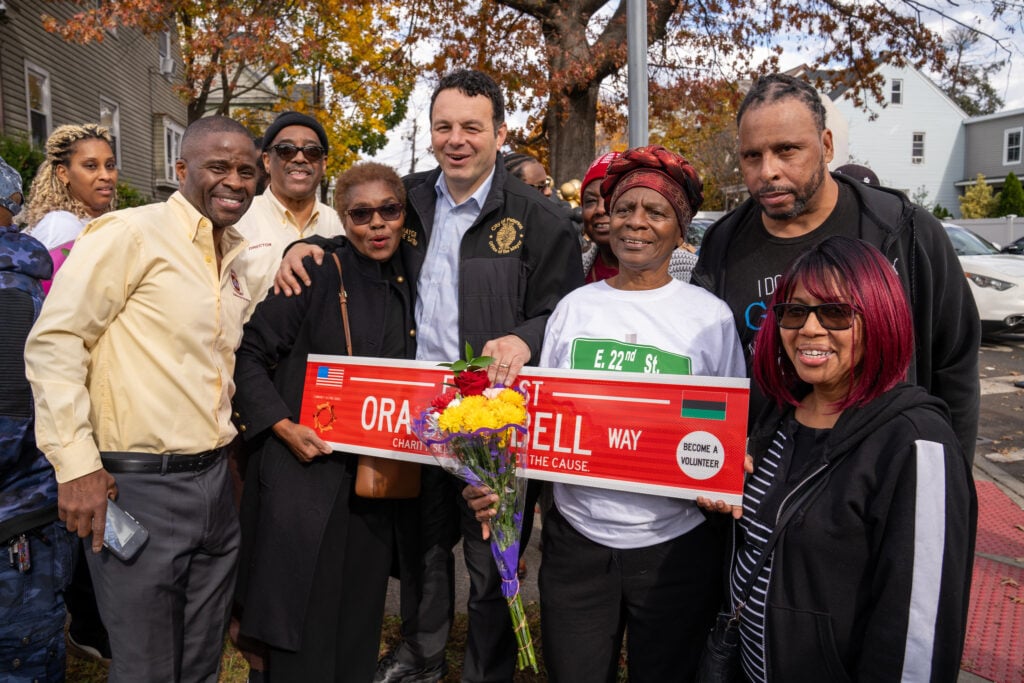
On November 9, 2025, more than 100 people gathered on East 22nd Street in Paterson, New Jersey, to witness a rare honor: the unveiling of “Ora Jane Bell Way.” The red and white street sign, inscribed with “Charity Sees the Need, Not the Cause,” stands as a testament to a woman whose life has been defined by compassion, resilience, and faith.
Born in New Jersey to parents from the South, Ora Jane Bell was raised with a strong sense of community and responsibility. Her mother’s roots in South Carolina shaped her values early on, instilling in her the belief that helping others is not optional — it’s essential. Paterson itself has transformed dramatically, shifting from an industrial hub to a diverse city with significant Latino and Palestinian populations. Through these changes, Bell has remained a constant source of compassion and service.
When asked about the street renaming, Bell’s response was heartfelt: “It was … something that you can’t imagine. And the best part is I’m still alive. Usually, they name streets after people once they expire.” Her joy was shared by her family, including her four children, all of whom attended the ceremony and testified to her lifetime of service. Also in attendance were several civic leaders, church and community members, and North American Division Adventist Community Services director W. Derrick Lea. Guests wore buttons designed by her daughter, Rhonda, that read “East 22nd Street” and “Ora Jane Bell Way.”
In his opening remarks, André Sayegh, Paterson mayor and lifelong resident, expressed, “We could have called this street Ora Jane Bell Boulevard. We could have called it Ora J Bell Street. But we called it Ora Jane Bell Way because her way is guided by God, and her way is to serve those who are most vulnerable, who may not have a voice.”
As Sayegh noted, her journey of faith underpins her legacy of service. A first-generation Seventh-day Adventist, Bell recalls always being aware of the Fourth Commandment but never receiving clarity on this theological question in her previous denomination. “The Bible says, ‘Remember the Sabbath day to keep it holy,’” Bell explained. “So if your mother says remember something, it means you can’t forget. Then why can God say remember and you forget?”
Her search for answers eventually led her to the Adventist Church after filling out a card for The Bible Story children’s books by Arthur Maxwell. Bell hoped to use the books to teach children from her church on Saturday mornings while their parents ran errands. After more than a year of Bible studies with three dedicated colporteurs, she was baptized in 1978 at the age of 25.
Joining the church deepened her commitment to service. “When I came into the church back in the ’70s, everybody had something to do. You didn’t come to church and sit down,” she explained, noting that she got involved with community service from day one.
Bell’s remarkable service record spans church ministries and community organizations. For 18 years, Bell has volunteered at Eva’s Soup Kitchen, and since retiring, she spends every Monday there. She also plays a key role in the Adventist Community Food Pantry, which distributed 400 bags of food weekly during the height of the COVID-19 pandemic. “It’s only through the grace of God that we made it,” she recalls, describing the laborious process of renting U-Haul trucks to collect food before the Food Bank of Hillside began delivering. The pantry still serves roughly 350 people on the first and third Wednesdays of each month.

Behind her decades of service were seasons of personal and professional struggle. Bell endured years of economic instability, sometimes relying on public assistance — experiences that eventually drove her to become the first in her family to complete a bachelor’s degree. She also later lost a job in the criminal justice system because she refused to work on the Sabbath, yet Bell views those struggles as formative. “God has plans for you that you don’t even know,” she reflected. Those experiences later deepened her empathy while working at the Passaic County Board of Social Services and expanded her ability to advocate for families facing food, housing, and mental health challenges.
Bell’s advice to young people aspiring to serve is frank and practical: “Be kind to people. Don’t look down on somebody; it could have been you.” Over the years, that kindness often meant opening her own home to people in need, offering shelter when they had no one to turn to. She also speaks candidly about the growing challenges of service in an unsafe world, sharing a sobering story of someone she helped breaking into her home.
When asked what legacy she hopes Ora Jane Bell Way will carry for children growing up there, her answer was simple, yet profound: “That they care about people, don’t look at what somebody’s done, and to volunteer.” And if Paterson could hear one message from her today? “First of all, love yourself. And if you can love yourself, you can love others.”
Ora Jane Bell Way is more than a street. It’s a symbol of what one life, rooted in faith and love, can accomplish. And for Paterson, it’s a reminder that true greatness lies not in wealth or status, but in service.
Written by Ronnie Mills, with additional reporting by Christelle Agboka.